Showing posts with label participation. Show all posts

Friday, 10 December 2021

Content on the Disability Royal Commission in Easy English.

Where is it?

There is so much written content being created for the Disability Royal Commission

When we are doing many of our consumer reviews of Easy English on other topics, the many people we engage with with low literacy do not know about the Royal Commission. 

How is this possible? 

Look around you. Look at where content is published? Look at how it is being conveyed to the wide number of people with disabilities. People with disabilities have a wide range of different abilities.

Content is on their website and social media (I see some of their  posts on Twitter) . What other social media do you see the Royal Commission on? There is nothing on their website about their social media presence.  Very occasionally we hear about the Disability Royal Commission on some news services. Very very occasionally there are guests on interactive news and current affairs shows, like The Drum where it is discussed.

Where is the written content and information for people who prefer simple and clear written information?

How do you find it?

Is it fit for purpose?


Does it cover everything you need to know, that people with highly skilled literacy can read about?

I wrote a submission on their Draft Accessibility Strategy in August 2019. I did get a response, but nothing was changed because of the issues I raised. It is also not listed on the public list of documents. I can send you a copy, if you email me.

Last year, I wrote a second submission, this time on Emergency responses (Bush-fires) and COVID19 responses. In it I highlighted the huge issues for people with low literacy, and what our service provided pro-bono as no government service was doing this work. In late August 2020, we had over 120 separate pieces of information in fact sheets and posters on our website about COVID19 in Easy English. About 20 fact sheets and posters are still available here.  

Once again this submission has not been put on the public list of submissions. It has been handed to another department of the Royal Commission as a general submission. I can email you a copy of this also.

The Royal Commission are developing Easy Read. As with much of my investigations on the differences between Easy English and Easy Read, the Disability Royal Commission Easy Read is very complex and difficult to understand, even for people with good literacy. Read these 2 blogs from 2020 about the differences

Firstly can you find the Easy Read on the website? They are never printed and distributed. This assumes high levels of digital inclusion and digital literacy to be able to access and locate them. Even if you go to the document library, you can not tick a box for Easy Read.

Print screen of your choice of document type.
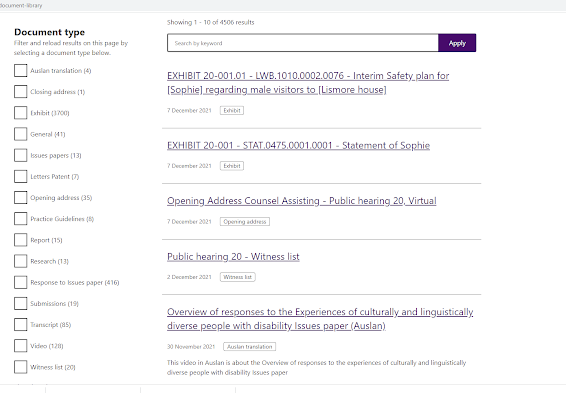


Here is the Issues paper in Easy Read on Violence and abuse at home.

Firstly, imagine you are a non reader. Do you have any idea what this book/paper/report is about? First impression are important. 

Will you bother picking it up? 
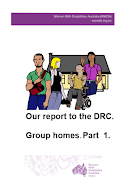


In comparison, here is the Easy English version on the 

As a non reader, do you have any idea what this book/paper/report may be about from the front cover? Will you consider opening it?

This has been developed in Easy English, which includes every day words of the intended reader, images that connect for that audience, clear and logical layout. It has also been consumer reviewed by a female identifying person with low literacy who has experience of group homes.

It would be great if the Disability Royal Commission actually commissioned the simplest type of written content for people to read. 

We welcome conversation about how to make this possible. 

Then more people with low literacy may be able to participate. the Disability Royal Commission will hear about more and different types of abuse, such as many people still do not know the Royal commission is currently running.

Cathy

Cathy Basterfield

Access Easy English

Telephone: 0466 579 855

Email: cathy@accesseasyenglish.com.au
Website: https://accesseasyenglish.com.au/

Facebook: https://www.facebook.com/accesseasyenglish

Blog: http://accesseasyenglish.blogspot.com.au
Twitter: @accesseasyengli

LinkedIn Cathy Basterfield


Monday, 24 August 2015

2016 census and impact for people with low literacy

Recently it was announced the 2016 Australian census will be going ahead.
But it will be online.

In the attached information, it is acknowledged that there will be some people who will not want to do it on line, but they expect over 2/3 of all households to use the online version.


It is difficult to see how these numbers/data add up, when the ABS(1) has data that tells us that 44% of the adult population has non functional literacy. Of more concern is that the same research in 2013 also identified 63% of the adult population has non functional technology based problem solving literacy (that means using the computer to access information and interpret meaning). Of that number over 12% were unable to participate in this part of the research, as they were unable to access the basic requirements if using a computer, and only

A number of yrs ago research identified significant proportions of people can access computers, but mostly it is social media. (2) This data was focused on young people 'so called first generation computer users.' ACMA (3) research from 2010 identified people over 55 are over-represented in the non-functional users of computers and technology group. Remember too, this data was collected from people who do identify as literate.

Are the silent non-functionally literate in our community going to be able to be properly included in the census data collection.  These are the people who demographers and planners do need to know about.

So who are these people?
Can you identify them in your community also. Here are some examples.

1. Retired man, highly literate, who left the workforce over 20 yrs ago. Has access to a computer but only uses the internet for emails
2. Married woman with mild intellectual disability. Uses a mobile phone to contact her husband (using voice) they do not own a computer
3. Elderly country lady. Does not own a computer
4. Woman with mild intellectual disability. Lives on her own. Does not own a computer. Uses a mobile phone for conversation (but not text)
5. Woman who owns a computer can use it for a variety of word and document based tasks. Does not have access to the internet.
6. Clients in a CRU. There is a computer in the staff room, but no one who lives in the CRU accesses the computer or internet.
7. People who live in a CRS. Do not have access to a computer or the internet. May be able to access at their local library, but will they be able to read the information, without support?
8. People who have English as a second language.


Anyone who does not regularly access a computer has additional vulnerabilities around completing forms, and security and "what if I put in the wrong thing , by accident"

May be 2/3 of households do have the skills to do something online.... but do they have the confidence to do this task online?

Let the census data collection agency know your concerns for people you know, or people you support. Only then will change happen. Ask them to make sure an Easy English version of the census is available. We need everyone to be included and participate. It is a Right.

Cathy Basterfield
Access Easy English

0466 579 855


References

Norman and Skinner (2006)   eHealth Literacy: Essential Skills for Consumer Health in a Networked World

Monday, 16 February 2015

Advocate, Participate, Include Me


In yesterday Sunday Age, there is an article about Michael Sullivan who presented at the recent Having a Say conference run by VALID in Geelong.

Michael proposed the NDIS or National Disability Insurance Scheme should be renamed the National Disability Investment Scheme.  So powerful is the new name Michael gave for the NDIS, that it become its unofficial name during the conference. Colleen Pearce, the Victorian Public Advocate embraced it, as did others.

So what is in a name?

A lot!

It is about expectations, and ownership and perceptions.

Invest in me.... see what is possible. People, who live with a disability, want to be part of their community, not living around its edges.
 
How does the person you support participate, and make decisions? Does everyone understand how the person communicates?

Can this be improved?

It is important that a person's communication system is valued.  When was the last time the person you support had their communication assessed? Are there other ways everyone could be communicating with the person you support?

 Ask for an assessment and review of the person’s communication. Put it in their plan, and then follow this up with an appropriate Speech Pathology assessment and intervention plan.

Cathy


Cathy Basterfield
Speech Pathologist
Access Easy English
0466 579 855 

Monday, 16 December 2013

Plans for 2014

Thank you to the many people who have shown such interest in Easy English and have begun or continued the process of planning and developing Easy English documents during the last 12 months.

As the Christmas break approaches, and the new year arrives, it is a great time to review the place of Easy English in your communities and for your workers. 

Have the recently released PIAAC http://www.abs.gov.au/AUSSTATS/abs@.nsf/Lookup/4228.0Main+Features12011-12?OpenDocument results or PISA http://www.acer.edu.au/documents/PISA-2012-In-Brief.pdf results generated much discussion in your organisation? Do you need to know more about these significant international surveys on functional literacy?

Has the priority for developing Easy English shifted in your organisation in the last 12 months?
What are the plans for including Easy English development in new projects in 2014?
Do your staff need training and support to write or develop their skills in Easy English?

Watch this space for some new resources which are due out early in the new year.
I am also planning to run some training in 2014 (short modules and full day) based on feedback from you. Keep checking my blog for when they are announced, or go to my website. www.accesseasyenglish.com.au
 
I will be available in January, however, will be working reduced hours.  Please leave me an email or phone message about your Easy English questions, projects or quotes you may need.

Cathy Basterfield
0466 579 855
cathy@accesseasyenglish.com.au
www.accesseasyenglish.com.au