Showing posts with label inclusion. Show all posts

Monday, 21 February 2022

Accessibility not. A personal experience at COVID19 testing 2022

Black & white photo Lady smiling at the camera. of head shot.
Cassandra Wright-Dole

Since the early 1980s, I have watched people’s faces as a matter of necessity. My slow but progressive hearing loss meant I acquired considerable lipreading skills from a young age before my profound sensorineural deafness was diagnosed at six years old. 

When COVID-19 began gaining momentum in Australia in 2020 and the mask mandates were first announced, I sat in my car outside the chemist sobbing uncontrollably to my parents on Facetime. After 35 years of successfully reading lips to communicate with hearing people, I was once again a bewildered three-year-old child, surrounded by meaningless noises laden with social expectations. 

In many ways, the lockdown was my saviour, protecting me from the uncomfortable task of dealing with people who thought that simply turning up the volume of their voice behind three layers of fabric would cure me of my disability.

 While lockdown gave me a layer of protection from dealing with the masked world in a general sense, an unavoidable aspect of the COVID-19 world is the need to be tested. The recent high case numbers of Omicron infections, extended family members testing positive following the new year celebrations, and the lack of available Rapid Antigen Tests saw my husband, our son and I in line for a standard PCR test. We had been fortunate enough until then, and it was only my second test and their first.

 When I reached the end of the line at my first testing experience, six and a half hours later, my human rights weren’t the foremost thing on my mind. I was too drained and exhausted to process the extent to which I was dependent on the kindness of strangers to understand what the nurses required of me or to inform the nurses that I was deaf and lipread. I was just relieved that I was inching closer to the finishing line. However, as someone employed in the accessibility field, I was conscious that my literacy ensured a smoother transition from the hot sun into the sterile testing hub. There was nothing to support independent access to information for someone with low literacy, English as a second language, or an intellectual disability. To the best of my knowledge, no one was employed to provide communication support where required.

 If my first test was infamous for the six and half hours spent in line, the second test was notable for the epiphany it brought. Being triple-vaxxed at the time of my second testing experience, I was happy with my experiences at the vaccination hub. Masks were removed to speak to me upon request, I was positioned where I was visible, and staff were informed of who I was, where I was, and (perhaps best of all) that they needed to remove their face mask to communicate with me. I understand the stakes are much higher at the testing sites, and testing staff will not remove their PPE to speak with a D/deaf person. While entirely understandable from an OH&S perspective, there must be alternatives that will facilitate informed and independent communication competently.

 While I had been unenamoured by the forced dependency on the kindness of strangers when being tested alone the first time, the presumption that my husband had a carer role and would speak for me was tacky at best. For context, my husband is a disabled veteran. His disability does not stand out the way mine does, and according to the Australian Government - I am the carer for both my husband and autistic son. When it comes down to who is best able to answer the relevant questions in these situations – for us – it is me. Having been through testing before, I was aware of the administrative process and prepared to advocate for myself – no kindness of strangers required. Despite my preparedness, the nurse assigned to me continued to engage my husband rather than communicate with me directly. For the sake of retaining my mental health, I have learned to breathe through the experiences that deny me the opportunity to have access to information or to speak for myself.

 If we ask ourselves, ‘are frontline COVID-19 staff being supported at a policy level to engage with people who are d/Deaf, have low literacy or have complex communication needs,’ the answer is still a resounding no. Two years into this pandemic, it’s simply not good enough.

 Cassandra Wright Dole


Specialist Content Writer

Access Easy English

Email: cass@accesseasyenglish.com.au
Website: https://accesseasyenglish.com.au/
Facebook: https://www.facebook.com/accesseasyenglish
Twitter: @accessEEwriter 

LinkedIn linkedin.com/in/casswright


Friday, 10 December 2021

Content on the Disability Royal Commission in Easy English.

Where is it?

There is so much written content being created for the Disability Royal Commission

When we are doing many of our consumer reviews of Easy English on other topics, the many people we engage with with low literacy do not know about the Royal Commission. 

How is this possible? 

Look around you. Look at where content is published? Look at how it is being conveyed to the wide number of people with disabilities. People with disabilities have a wide range of different abilities.

Content is on their website and social media (I see some of their  posts on Twitter) . What other social media do you see the Royal Commission on? There is nothing on their website about their social media presence.  Very occasionally we hear about the Disability Royal Commission on some news services. Very very occasionally there are guests on interactive news and current affairs shows, like The Drum where it is discussed.

Where is the written content and information for people who prefer simple and clear written information?

How do you find it?

Is it fit for purpose?


Does it cover everything you need to know, that people with highly skilled literacy can read about?

I wrote a submission on their Draft Accessibility Strategy in August 2019. I did get a response, but nothing was changed because of the issues I raised. It is also not listed on the public list of documents. I can send you a copy, if you email me.

Last year, I wrote a second submission, this time on Emergency responses (Bush-fires) and COVID19 responses. In it I highlighted the huge issues for people with low literacy, and what our service provided pro-bono as no government service was doing this work. In late August 2020, we had over 120 separate pieces of information in fact sheets and posters on our website about COVID19 in Easy English. About 20 fact sheets and posters are still available here.  

Once again this submission has not been put on the public list of submissions. It has been handed to another department of the Royal Commission as a general submission. I can email you a copy of this also.

The Royal Commission are developing Easy Read. As with much of my investigations on the differences between Easy English and Easy Read, the Disability Royal Commission Easy Read is very complex and difficult to understand, even for people with good literacy. Read these 2 blogs from 2020 about the differences

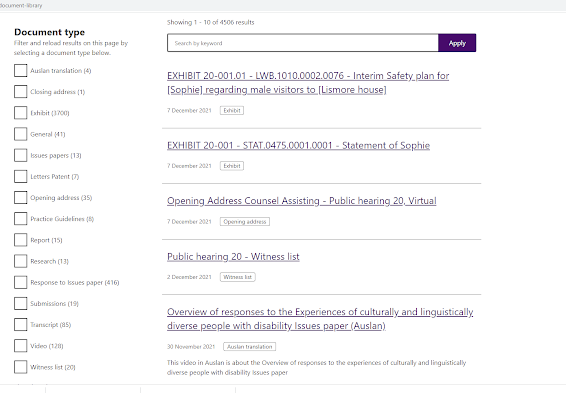
Firstly can you find the Easy Read on the website? They are never printed and distributed. This assumes high levels of digital inclusion and digital literacy to be able to access and locate them. Even if you go to the document library, you can not tick a box for Easy Read.

Print screen of your choice of document type.


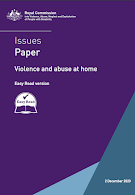
Here is the Issues paper in Easy Read on Violence and abuse at home.

Firstly, imagine you are a non reader. Do you have any idea what this book/paper/report is about? First impression are important. 

Will you bother picking it up? 


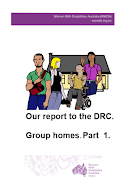
In comparison, here is the Easy English version on the 

As a non reader, do you have any idea what this book/paper/report may be about from the front cover? Will you consider opening it?

This has been developed in Easy English, which includes every day words of the intended reader, images that connect for that audience, clear and logical layout. It has also been consumer reviewed by a female identifying person with low literacy who has experience of group homes.

It would be great if the Disability Royal Commission actually commissioned the simplest type of written content for people to read. 

We welcome conversation about how to make this possible. 

Then more people with low literacy may be able to participate. the Disability Royal Commission will hear about more and different types of abuse, such as many people still do not know the Royal commission is currently running.

Cathy

Cathy Basterfield

Access Easy English

Telephone: 0466 579 855

Email: cathy@accesseasyenglish.com.au
Website: https://accesseasyenglish.com.au/

Facebook: https://www.facebook.com/accesseasyenglish

Blog: http://accesseasyenglish.blogspot.com.au
Twitter: @accesseasyengli

LinkedIn Cathy Basterfield


Wednesday, 15 April 2020

Using images to create meaning for COVID19


Thanks to The Workshop NZ for their blog discussion on clear and effective communication. 

posted on 2 April 2020 titled " Lifting people's gaze, a communications formula and concrete language."

They describe the importance of providing positive messages and steps for change, rather than focusing on the negative things we may be doing and using the language of blame and blame shifting.

An excerpt from
their blog

"During COVID-19 we want to enhance the interconnections we have with each other. We also need people to think about how those with the most influence can support us. People in government and employers have a significant role in helping us cope with staying at home and being mentally well. Our communications should focus there. 

We call this lifting people's gaze away from individual behaviour and choice and up to the systems and structures that have a much more powerful influence on shaping our lives and those behaviours. It is a kinder, more effective way to encourage the actions we want during times of fear and anxiety."

In just the same way, Easy English prefers to include information on what 'to do.'
Eg: You must stay at home.
Lots of things are closed. Like XXXXXX

The Workshop blog goes on to explain it is important to include concrete information.


From their blog again
“ HERE ARE SOME EXAMPLES OF HOW TO MAKE YOUR LANGUAGE ABOUT COVID-19 MORE CONCRETE
Try staying at home instead of self-isolating.
Try stay within two kilometres of home instead of stay local.
Try contact tracing officers, researchers, and analysts instead of public health workers (most people don't know about public health workers and think healthcare starts and ends with doctors and nurses).
Try keeping  two metres between us instead of physical distance or bubble.

A great example of being very concrete on physical distance:’


It is great to see The Workshop illustrating this last point with one of Access Easy English' posters on COVID19. It is critical that all images selected are as clear and concrete for Easy English content. And it must be all through the document.
You could spend lots of time working out the language elements. Selecting clear and concrete images to support the messages is as critical to making your Easy English document accessible.

Learn more about choosing images when you come to my training.
Currently I am advertising the first online 2 day Easy English training. Face to face training is still being advertised in Sydney and Melbourne at the moment. However, I am not sure they will go ahead with the current restrictions. As soon as travel restrictions are lifted more face to face in other cities will be advertised.

Keep up to date with the evidence based quality Easy English COVID19 resources and training opportunities via my social media or email me and I will add you to my mailing list.

Stay safe

Cathy
Cathy Basterfield
Owner Access Easy English
Consultant – Speech Pathologist
Telephone: 0466 579 855

LinkedIn: Cathy Basterfield
Blog: http://accesseasyenglish.blogspot.com.au
Twitter: @accesseasyengli


Friday, 26 October 2018

Numeracy and Literacy at Work


This month I attended the #Employment SolutionsConference on the Gold Coast.
It was great to meet a range of different people working to support people with different needs to access employment.

I presented a paper on Day 1; Easy English:  A critical addition to workplaces.

Although a small audience it generated much discussion.

I included in my paper some recent research from the Australian Industry Group Survey Report Skilling:A National Imperative; Workforce Development Needs 2018.

In this report it identified 72% of organisations are moderately or highly affected by poor literacy and numeracy. This in turn contributes to a range of negative and poor outcomes from:
- poor completion of workplace documents/reports;
- material wastage/material errors/noncompliance;
- time wasting;
- recruitment difficulties;
- staff lack confidence/unwilling to take on new work;
- financial miscalculations;
- teamwork problems/communication problems;
- potential for workplace injuries or unsafe work practices.

Today in the Sydney Morning Herald an article by Anna Patty reported 

             ' The Australian Industry Group survey of 298 companies with a total of   
              111,209 employees across manufacturing, construction, mining and service   
               industries found 99 per cent reported that low levels of literacy and numeracy
               were affecting the business.'

Unfortunately this is not surprising when the general prose literacy of the adult Australian population suggests 44% of adults 16-65yrs old do not have the literacy to manage a range of day to day reading tasks. ABS#2448, 2013.

The value of providing written material in Easy English could not be more obvious. Yes, it would be great to teach workers the literacy skills they need for work, but that is the long term strategy.

Today, that person needs to work. He needs to know the
- process to be safe at work and reduce workplace injures; 
- how to communicate and write a brief of notes about that days tasks (or read it from the manager); 
- work out how much of a certain substance or product is needed, and calculate how many portions are required, even estimate how long a task will take;
- do his task efficiently, and be prepared to take on new or different tasks;
and
- work effectively with other team members.

These are a couple of examples of Easy English.
Training and self development; Safeguards project;
 
The next 2 day Easy English training is in Adelaide in November. Register now and join the growing number of organisations who write information so it is meaningful and functional for all workers.

Talk to me about a project to develop your information so that more people can read, understand and know what to do.

Cathy

Cathy Basterfield
accesseasyenglish.com.au
 cathy@accesseasyenglish.com.au
0466 579 855