Showing posts with label Australia. Show all posts

Monday, 14 February 2022

NSW CID present Plenary at ASID 2021


It was great to hear Jemima McDonald and Pamela Darling from the NSW Council for Intellectual Disability (NSWCID) presenting their plenary at ASID2021.

They made some important points about Easy Read documents. They said that

·      It must be easy to read and understand, 

     but 

     understanding is the key

·      There are no Australian standards. They noted that there is a variety of styles used in Easy Read in Australia

·      NSWCID includes people with an intellectual disability both in co-design and peer review of documents

·      Users of Easy Read may be people with low literacy or those for whom English is not their first language

    Easy Read can be read independently or with support as an interactive tool by workers or family and friends

·      Easy Read is not for everyone.  

Their key working principles are similar to the European Easy Read. Some important elements are

·      the use of white space

·      clear easy words

·      images

·      reduced number of key messages. No more than 10 in a document

·      limit pages to 10 (or up to 20). Break information into separate documents rather than make too long.


Images

Comments made during presentation were

·      engagement of readers can be enhanced by the use of seeing people you recognise in the images. This may help people be connected to the content and feel represented. This is relevant for cultural representations

·      carefully selected images allow you to use less words and sentences

·      do not make the images condescending to an adult audience. Images should be age appropriate and look good.

How does this differ from Easy English principles for the use of images?

Easy English also aims to use images that are relevant to the audience.

Images are chosen to provide the clearest representation of the text. As with the use of commonly used and recognised words, Easy English will use a picture that is most likely to make sense to the reader.

Easy English does not use photo images primarily but sometimes a photo is the best way to represent a familiar item to the audience. For example a photo of a diabetes test kit or a particular building, rather than a drawing type image.

We have regularly found the use of photos of people and 'representative places' appears to be less valuable. Some consumer groups say they prefer photos of people and others do not like photos of people as they seem to represent only the person in the picture rather than ‘anybody’. The exception is of course if the content is about a particular person or place. Then a photo is valuable. This would be the case for

·      the person to contact,

·      the mayor of your council

·      the place to meet for your meeting.

The concept of age appropriate images is complex. It is not simply the case that coloured pictures are childlike. Consumer feedback has told us that clear simple images using colour make the image easier to understand. However images for an adult audience should reflect real life experience. For example an image of real money, a wallet or keycard are preferable to a piggy bank image.

At Access Easy English our consumer reviews provide feedback about the images chosen. We ask people who are likely to be the intended audience to review the work with us. This helps us to match the images as closely as possible to the content.

You can read here and here for a discussion on the comparison of Easy Read and Easy English.

Talk to us about what this could look like for your organisation.

Rachel and Cathy

Cathy Basterfield
Owner Access Easy English
Consultant – Speech Pathologist
Telephone: 0466 579 855
Email: cathy@accesseasyenglish.com.au


Friday, 10 December 2021

Content on the Disability Royal Commission in Easy English.

Where is it?

There is so much written content being created for the Disability Royal Commission

When we are doing many of our consumer reviews of Easy English on other topics, the many people we engage with with low literacy do not know about the Royal Commission. 

How is this possible? 

Look around you. Look at where content is published? Look at how it is being conveyed to the wide number of people with disabilities. People with disabilities have a wide range of different abilities.

Content is on their website and social media (I see some of their  posts on Twitter) . What other social media do you see the Royal Commission on? There is nothing on their website about their social media presence.  Very occasionally we hear about the Disability Royal Commission on some news services. Very very occasionally there are guests on interactive news and current affairs shows, like The Drum where it is discussed.

Where is the written content and information for people who prefer simple and clear written information?

How do you find it?

Is it fit for purpose?


Does it cover everything you need to know, that people with highly skilled literacy can read about?

I wrote a submission on their Draft Accessibility Strategy in August 2019. I did get a response, but nothing was changed because of the issues I raised. It is also not listed on the public list of documents. I can send you a copy, if you email me.

Last year, I wrote a second submission, this time on Emergency responses (Bush-fires) and COVID19 responses. In it I highlighted the huge issues for people with low literacy, and what our service provided pro-bono as no government service was doing this work. In late August 2020, we had over 120 separate pieces of information in fact sheets and posters on our website about COVID19 in Easy English. About 20 fact sheets and posters are still available here.  

Once again this submission has not been put on the public list of submissions. It has been handed to another department of the Royal Commission as a general submission. I can email you a copy of this also.

The Royal Commission are developing Easy Read. As with much of my investigations on the differences between Easy English and Easy Read, the Disability Royal Commission Easy Read is very complex and difficult to understand, even for people with good literacy. Read these 2 blogs from 2020 about the differences

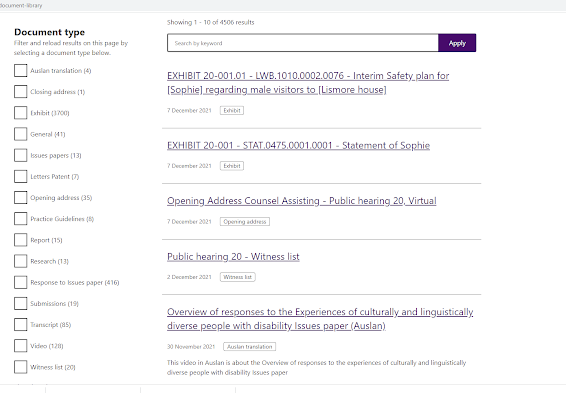
Firstly can you find the Easy Read on the website? They are never printed and distributed. This assumes high levels of digital inclusion and digital literacy to be able to access and locate them. Even if you go to the document library, you can not tick a box for Easy Read.

Print screen of your choice of document type.


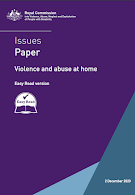
Here is the Issues paper in Easy Read on Violence and abuse at home.

Firstly, imagine you are a non reader. Do you have any idea what this book/paper/report is about? First impression are important. 

Will you bother picking it up? 


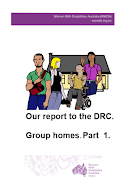
In comparison, here is the Easy English version on the 

As a non reader, do you have any idea what this book/paper/report may be about from the front cover? Will you consider opening it?

This has been developed in Easy English, which includes every day words of the intended reader, images that connect for that audience, clear and logical layout. It has also been consumer reviewed by a female identifying person with low literacy who has experience of group homes.

It would be great if the Disability Royal Commission actually commissioned the simplest type of written content for people to read. 

We welcome conversation about how to make this possible. 

Then more people with low literacy may be able to participate. the Disability Royal Commission will hear about more and different types of abuse, such as many people still do not know the Royal commission is currently running.

Cathy

Cathy Basterfield

Access Easy English

Telephone: 0466 579 855

Email: cathy@accesseasyenglish.com.au
Website: https://accesseasyenglish.com.au/

Facebook: https://www.facebook.com/accesseasyenglish

Blog: http://accesseasyenglish.blogspot.com.au
Twitter: @accesseasyengli

LinkedIn Cathy Basterfield


Thursday, 9 December 2021

Easy English for a Virtual Conference 2021

Last month was the Australasian Society of Intellectual Disability (ASID) Conference. It was a virtual conference, like so many others have been in the last 18 months.

Being a virtual conference raises many issues regarding access to the digital platform for functional and meaningful engagement and learning opportunities.

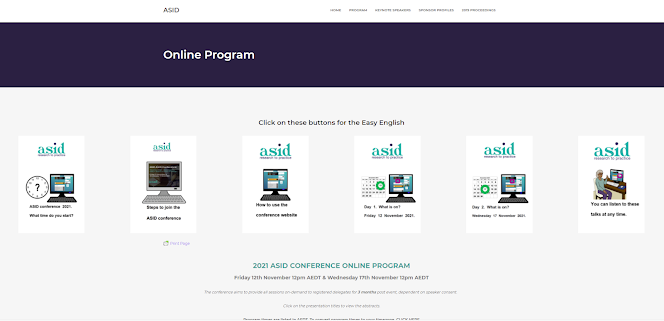
We were the Silver Access Sponsor at the ASID conference. We developed 6 fact sheets in Easy English. We have had some comments that we have included lots of detail in how to set up and how to find things on the conference website. Having low digital literacy does mean you are less likely to be included.  

View of the Easy English fact sheets on the website ready for people at the conference to use.


The fact sheets were

·         What time do we start?

·        Steps to join the ASID conference

·        How do I use the conference website

·        Day 1 program

·        Day 2 program

·        You can look at these at any time.

 It is worth considering the most recent data from the AustralianDigital Inclusion Index, which was released in October 2021 for Digital Literacy. It noted that those with high digital inclusion prior to the pandemic have increased their digital literacy skills. However, for those with low and poor digital literacy, their digital inclusion has stayed the same. So, over the last 18 months the gap between has increased. The 2021 data did not include Aboriginal and Torres Strait Islander people nor people from the Northern Territory.

Look back at the 2020 data also (Scroll down the page a little to find it) as it does include Aboriginal and Torres Strait Islander people and people from the Northern Territory. It notes

·        2.5 million people do not have access to the internet;

·        4 million people only access the internet via a mobile phone. It limits their access to data but also being able to read content on websites in a reasonable size font, and even be able to readily connect to a printer to have a printed copy.


Who else is likely to have low digital inclusion indices?

·        House hold income Q5 ($35K)

·        Aged 65 +

·        Less than secondary education

·        People with Disability

·        Household income Q4 ($60k)

·        Not in workforce

·        Indigenous Australians

·        Older people. 

Rachel and Lisa from the Bumpy Road project presented a paper at the  conference on developing Easy English content on NSW Child protection issues for an Easy to use website. We supported their work in developing 31 Easy English fact sheets and a simple set up and navigation of the website.  www.bumpyroad.org.au

There was also another paper at the conference which discussed the issues for people with low digital inclusion before the pandemic and what they needed support with to stay connected during the pandemic. See a later blog from Rachel.

Cathy Basterfield

Owner Access Easy English
Consultant – Speech Pathologist

Telephone: 0466 579 855


Email: cathy@accesseasyenglish.com.au
Website: https://accesseasyenglish.com.au/


Facebook: https://www.facebook.com/accesseasyenglish
Blog: http://accesseasyenglish.blogspot.com.au
Twitter: @accesseasyengli

LinkedIn Cathy Basterfield

Thursday, 16 April 2020

Posters. Accessible written content


In the last blog I talked about the importance of the first impression.

Your first impression is the visual impression.

Irrespective of whether you creating a poster or document or brochure some other things are just as important.

  • Consistency - where are the images consistently?
  • Predictability - where do I go next/what do I read next?
  • What is the topic? Should this content be in more than 1 poster or brochure or document. Mostly for Easy English this is a definite yes.


Let's look at 2 posters created for COVID19 recently.
1) Developed by Australian Easy English Writer 

2) UK developed Easy Read for an Australian audience.

Australian Easy English 


UK developed Australian content Easy Read  


Element


Australian

Easy English


UK developed Australian
Easy Read


Title


With image


Multiple images left and right of image
Placement of images
Title on left of text.
Body, consistently on top of text
Title – left and right of text. 
Body of text - Most on left, but also on Right and above text
Use of white (empty) space


Yes
No
Double line space throughout


Yes
No
Images per page 


6
12
Space for each image
Yes
No. Often overlap
Selection of images


Symbols.

Used by people with disability


Photos.

Of people with disability.

UK models


Use of columns
Yes – minimum text and image
Yes – columns filled with text and images. One or two words per column width.
Use of
-       Bold
-       Sentence case
-       Italics

Yes – heading
Yes
No

Yes - heading and body of text
No. eg: DO NOT; CALL
Yes eg: CALL
Repetition
No
Yes – telephone number
Standard format for phone numbers
N/A
No
Topic
1 per poster
Multiple topics

Even with this small comparison there are significant differences in the 2 types of posters. This has an impact for our readers with more limited literacy. Visually the reader needs to ask where do I start: where do I go: which bit is important: what is the green triangle for?

Formatting such as sentence case only and no italics has been identified as 2 elements which all readers need. Why then should a document that has an intended audience of people with lower literary have these elements in their document?

Some language differences.
Although only a small sample, the differences in these posters reflect what I discovered in the larger language analysis completed using 5 documents in Easy English and 5 documents in Easy Read, rather than single page posters. 

Element


Australian

Easy English 
Poster L        Poster R

UK developed Australian
Easy Read
Number of words
13                       26
58
Use of grammatical markers, eg ing, ly, plural
1 -plural            2 - plural
6
– ing – 2
-       ly – 1
-       ed – 1
-       plural - 3
Sentence length
1 sentence;        1 sentence;
Of 4 words        Of 4 words

7 sentences;
Ave 8.2 words long
Phrases
4 phrases.         6 phrases
Ave 2 word        Ave 3.5
long                   words long
0
If …then statements
0                         0
1
Use of conjunctions
Eg: ‘and‘  ‘or’
0                        0
3
Use of contractions eg: won’t 
0                        0
2
Everyday word use
COVID-19 or Coronavirus
COVID-19 (1)    COVID-19 (1)
Coronavirus (2)

 There are other areas for word analysis.
One is to look at the number of words with more than 1 syllable.

Element


Australian

Easy English

Poster L       Poster R
UK developed Australian
Easy Read
Words with more than 1 syllable
2                          5
2 syll – 1              2 syll - 5
3 syll - 1
11
2 syll – 8
3 syll –
4 syll –1
5 syll - 2
Percent of total words
15%                17%
18%
Number of words with more than 3 syllables
0                        0
 3 = 5%

 These findings are typical for all the comparative data I have collected between Easy English and Easy Read content. Keeping in mind that if someone has difficulty saying a word, they are less likely to understand the word and use it themselves. Additionally they are less able to make the connection with that word written down. In my typical consumer reviews, consumers have difficulty saying most words over 2 syllables in length. They rarely use them, and rarely know what they mean. 

All this analysis is critical to know about and be aware of as you construct your accessible content to provide best practice accessible, functional and meaningful information for everyone.

Let's agree that Easy English and Easy Read are different. Individually you may have a consumer who can manage more complex information. However, if that is all you develop for everyone you are leaving a substantial and very vulnerable cohort of people out of the circle of information.

Happy to talk with you about other data I have collected, and the impact on developing effective Easy English or book into my training. Learn more about how you can write effective and best practice Easy English. Details on my home page  


Easy English resources
Poster. Look for the signs https://bit.ly/3944NrJ
Poster. Look after your self.  https://bit.ly/2WxSl0L
Visit https://accesseasyenglish.com.au/covid-19-resources/ for all the Easy English resources


Stay safe, Cathy

Cathy Basterfield
Owner Access Easy English
Consultant – Speech Pathologist
Telephone: 0466 579 855