Showing posts with label website. Show all posts

Thursday, 9 December 2021

Easy English for a Virtual Conference 2021

Last month was the Australasian Society of Intellectual Disability (ASID) Conference. It was a virtual conference, like so many others have been in the last 18 months.

Being a virtual conference raises many issues regarding access to the digital platform for functional and meaningful engagement and learning opportunities.

We were the Silver Access Sponsor at the ASID conference. We developed 6 fact sheets in Easy English. We have had some comments that we have included lots of detail in how to set up and how to find things on the conference website. Having low digital literacy does mean you are less likely to be included.  
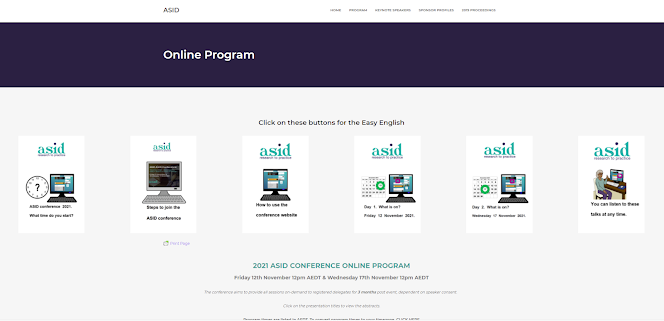
View of the Easy English fact sheets on the website ready for people at the conference to use.


The fact sheets were

·         What time do we start?

·        Steps to join the ASID conference

·        How do I use the conference website

·        Day 1 program

·        Day 2 program

·        You can look at these at any time.

 It is worth considering the most recent data from the AustralianDigital Inclusion Index, which was released in October 2021 for Digital Literacy. It noted that those with high digital inclusion prior to the pandemic have increased their digital literacy skills. However, for those with low and poor digital literacy, their digital inclusion has stayed the same. So, over the last 18 months the gap between has increased. The 2021 data did not include Aboriginal and Torres Strait Islander people nor people from the Northern Territory.

Look back at the 2020 data also (Scroll down the page a little to find it) as it does include Aboriginal and Torres Strait Islander people and people from the Northern Territory. It notes

·        2.5 million people do not have access to the internet;

·        4 million people only access the internet via a mobile phone. It limits their access to data but also being able to read content on websites in a reasonable size font, and even be able to readily connect to a printer to have a printed copy.


Who else is likely to have low digital inclusion indices?

·        House hold income Q5 ($35K)

·        Aged 65 +

·        Less than secondary education

·        People with Disability

·        Household income Q4 ($60k)

·        Not in workforce

·        Indigenous Australians

·        Older people. 

Rachel and Lisa from the Bumpy Road project presented a paper at the  conference on developing Easy English content on NSW Child protection issues for an Easy to use website. We supported their work in developing 31 Easy English fact sheets and a simple set up and navigation of the website.  www.bumpyroad.org.au

There was also another paper at the conference which discussed the issues for people with low digital inclusion before the pandemic and what they needed support with to stay connected during the pandemic. See a later blog from Rachel.

Cathy Basterfield

Owner Access Easy English
Consultant – Speech Pathologist

Telephone: 0466 579 855


Email: cathy@accesseasyenglish.com.au
Website: https://accesseasyenglish.com.au/


Facebook: https://www.facebook.com/accesseasyenglish
Blog: http://accesseasyenglish.blogspot.com.au
Twitter: @accesseasyengli

LinkedIn Cathy Basterfield


Saturday, 21 November 2015

Computer Literacy and Easy English


Have you ever thought about how much reading is involved in accessing a computer, or the internet?

If you can read well, you probably have not.

An article in this week’s Age newspaper (Melbourne) summarised the findings from recent Australian Curriculum Assessment and Reporting Authority research on Australian student’s use of computers and the internet. This is in-line with other research in the domain of computer literacy from ABS # 4228, 2013 and also ehealth literacy, both for Australian students and international students. This weeks research states 48% of Year 10 students have non functional computer skills to manage and process information. The ABS data identified non functional use of technology, that is, adults unable to use the computer based testing, and instead used paper based testing was 24%A significantly higher proportion of people were recognised as having non functional computer based problem solving skills. (Over 70%) This is consistent with many other OECD countries.

It would surprise many to hear the computer literacy for accessing meaningful information is extremely low, and in fact is non functional for a high proportion of the population. This is not about use of social media, and Instagram and such, it is about meaningful searches, access and use the breadth of information on the internet.

Then, consider the older population. Do you have older relatives or friends who do not own a computer, laptop or iPad? I do.  Do some own a computer, but are not connected to the internet? Yes, I can think of some people here too.

Often clients in group homes (called CRU's) or people in SRU's, do not have access to the internet, or wi-fi in their facilities. How do they access information?  Nursing Homes, hospitals and such. What is the access like here for patients?

On your website. What now?
That is great. But once someone with poor literacy has got past getting your web address right, can they find what they need on your website?
Look at your website. How much of your website is text?  What level of literacy does it requite to read, understand and use that text?

Ok, you could use a screen reader to read everything aloud, but often the language is too complex, too dense and does not relate enough to the person's experience. Once again another means to reduce their interaction with your website.

Where is your phone number and contact us section?
MMM. No phone number. Companies, and many government departments have recently done away with contact phone numbers, easily displayed. They want you to complete an email. Once again, great if you have the skills to type, spell and compose this information. In this current climate, when access to mobile phones is so much a part of our society, why do large organisations insist on an email? Every organisation should provide a multitude of ways the public can access them.

Now, I really need you to think about who is your audience. 
How do you make your website accessible to the 44 % of the adult Australian population with non functional literacy, over 70% of the adult Australian population with non functional technology based problem solving skills.  ABS # 4228, 2013 And these numbers will not reduce. Based on the data of the functional use of the computer by current school students, it is an ongoing issue which needs to be addressed.

Ask me how we can work together to begin to address this enormous issue by using the techniques of Easy English on your website.

Cathy

Cathy Basterfield
Speech Pathologist
Access Easy English
cathy@accesseasyenglish.com.au
www.accessseasyenglish.com.au
0466 579 855

Facebook.com/accesseasyenglish
Twitter @accesseasyengli  

References:
Australian Bureau of Statistics.2013.  Programme for the International Assessment of Adult Competencies. Accessed 21/11/2015

Australian Communications and Media Authority 2015. Use of digital media and communications by senior Australians Accessed 21/11/2015.
Australian Curriculum Assessment and Reporting Authority  2014. National Assessment Program –ICT Literacy Years 6 & 10 Report 2014
Cameron D Norman and Harvey A Skinner 2006 E-Health Literacy: Essential Skills
for Consumer Health in a Networked World. J Med Internet Res 2006;8(2):e9


Monday, 24 August 2015

2016 census and impact for people with low literacy

Recently it was announced the 2016 Australian census will be going ahead.
But it will be online.

In the attached information, it is acknowledged that there will be some people who will not want to do it on line, but they expect over 2/3 of all households to use the online version.


It is difficult to see how these numbers/data add up, when the ABS(1) has data that tells us that 44% of the adult population has non functional literacy. Of more concern is that the same research in 2013 also identified 63% of the adult population has non functional technology based problem solving literacy (that means using the computer to access information and interpret meaning). Of that number over 12% were unable to participate in this part of the research, as they were unable to access the basic requirements if using a computer, and only

A number of yrs ago research identified significant proportions of people can access computers, but mostly it is social media. (2) This data was focused on young people 'so called first generation computer users.' ACMA (3) research from 2010 identified people over 55 are over-represented in the non-functional users of computers and technology group. Remember too, this data was collected from people who do identify as literate.

Are the silent non-functionally literate in our community going to be able to be properly included in the census data collection.  These are the people who demographers and planners do need to know about.

So who are these people?
Can you identify them in your community also. Here are some examples.

1. Retired man, highly literate, who left the workforce over 20 yrs ago. Has access to a computer but only uses the internet for emails
2. Married woman with mild intellectual disability. Uses a mobile phone to contact her husband (using voice) they do not own a computer
3. Elderly country lady. Does not own a computer
4. Woman with mild intellectual disability. Lives on her own. Does not own a computer. Uses a mobile phone for conversation (but not text)
5. Woman who owns a computer can use it for a variety of word and document based tasks. Does not have access to the internet.
6. Clients in a CRU. There is a computer in the staff room, but no one who lives in the CRU accesses the computer or internet.
7. People who live in a CRS. Do not have access to a computer or the internet. May be able to access at their local library, but will they be able to read the information, without support?
8. People who have English as a second language.


Anyone who does not regularly access a computer has additional vulnerabilities around completing forms, and security and "what if I put in the wrong thing , by accident"

May be 2/3 of households do have the skills to do something online.... but do they have the confidence to do this task online?

Let the census data collection agency know your concerns for people you know, or people you support. Only then will change happen. Ask them to make sure an Easy English version of the census is available. We need everyone to be included and participate. It is a Right.

Cathy Basterfield
Access Easy English

0466 579 855


References

Norman and Skinner (2006)   eHealth Literacy: Essential Skills for Consumer Health in a Networked World